

Japanese Matcha Powder in Dubai

Green tea, turmeric root (15%), candied pineapple pieces (pineapple, sugar) (10%), ginger pieces, natural flavoring (contains milk), coconut chips (coconut, sugar) (5%), Matcha green tea (5%), rose petals.

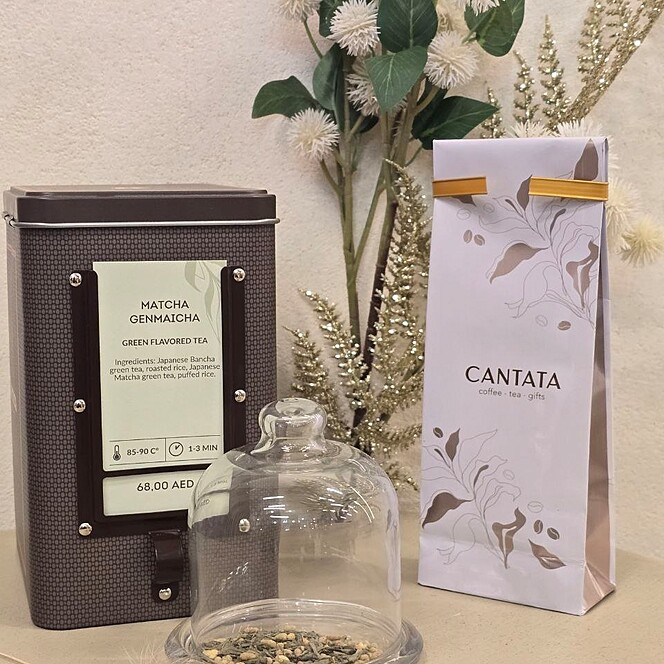
Ingredients: Japanese Bancha green tea, roasted rice, Japanese Matcha green tea, puffed rice.

It is beaten in a bowl with the help of a traditional bamboo whisk.
Matcha is the only tea you drink rather than steep. Instead of extracting flavour from leaf and throwing the leaf away, you whisk the whole leaf, stone-ground to a powder finer than flour, into suspension in water. You consume all of it, which is why matcha delivers more caffeine, more L-theanine and more chlorophyll per gram than any brewed green tea.
Cantata stocks organic Japanese matcha from Shizuoka alongside matcha-based blends, from AED 25. Leaf-form Japanese tea sits in the green tea collection.
How matcha is made
Matcha is not just ground green tea, and the two are not interchangeable.
For roughly three to four weeks before harvest, the bushes are covered to cut sunlight substantially. The plant responds by producing more chlorophyll and more L-theanine, and by converting less theanine into catechins. This is why matcha is vivid green and tastes savoury and sweet rather than bitter.
The picked leaf is steamed to halt oxidation, then dried without rolling. At this stage it is called tencha.
Stems and veins are removed. Only the leaf flesh goes forward
Granite mills grind the tencha slowly, because heat damages aroma. A traditional mill produces around 30 to 40 grams an hour. This is the main reason good matcha costs what it does.
Green tea powder made by grinding ordinary sencha in a steel mill is a different product entirely: browner, coarser, and bitter. It has its place in baking. It is not matcha. For a leaf tea with the same freshness, look at sencha in the green tea range instead.
Matcha blends in the range
Matcha Genmaicha combines Japanese bancha with roasted brown rice and a proportion of matcha stirred through. The rice adds a toasted, popcorn-like note and the matcha adds body and colour. It brews like a normal leaf tea rather than being whisked, and it is the gentlest introduction to the flavour.
Matcha Colada is a flavoured green tea blend with turmeric, candied pineapple, ginger, coconut and matcha. Fruity and sweet, and it works particularly well iced. Other blends in this style are in flavoured green tea.
How to whisk matcha properly
Most bad matcha at home is a technique problem, not a tea problem. Two rules solve almost all of it: sift, and do not use boiling water.
- Sift 1 to 2 g through a fine strainer into your bowl. Matcha clumps in storage and lumps will not whisk out. This step is not optional.
- Add 60 to 70 ml of water at 70 to 80 °C. Boiling water scorches matcha and makes it bitter and flat.
- Whisk in a W or M motion with a bamboo chasen from tea accessories, from the wrist, for 15 to 20 seconds. Do not stir in circles. You are aerating it, not mixing it.
- Drink it within a minute or two. Matcha is a suspension, not a solution, and it separates.
Usucha is thin matcha, roughly 2 g to 70 ml, and it is what most people mean by a bowl of matcha. Koicha is thick matcha, around 4 g to 30 ml, kneaded rather than whisked, and it needs top-grade leaf.
A milk frother works if you have no chasen, though the foam is coarser. A jar with a tight lid, shaken hard, works better than a spoon.
Making a matcha latte
- Sift 2 g of matcha into a cup.
- Add 30 ml of water at 80 °C and whisk to a smooth paste with no lumps.
- Add 200 ml of milk, hot or cold.
- Oat milk holds matcha better than almond, which tends to separate.
- Sweeten after tasting, if at all.
For iced matcha, whisk the paste with cold water, pour over ice, then add the milk. Whisking matcha directly into cold milk will leave you with lumps.
Caffeine in matcha
Because you consume the leaf rather than an infusion of it, matcha carries more caffeine per gram than brewed green tea. A 2 g bowl of usucha contains roughly 60 to 70 mg of caffeine, in the same range as a single espresso, though the figure varies with grade and dose.
Matcha is also high in L-theanine, and the shading process pushes it higher still. L-theanine is associated in research with a calmer quality of alertness than caffeine alone produces, which is the basis of the commonly heard claim that matcha energy feels steadier than coffee. The effect is real enough to be studied but modest, and individual response varies. Two bowls a day is a reasonable ceiling for most adults.
Storing matcha in Dubai
Matcha is more perishable than any leaf tea. Ground to a powder, the entire surface of the leaf is exposed to oxygen, and it fades fast.
- Keep it sealed, opaque and cold. An unopened tin can live in the refrigerator.
- Once opened, keep it in the refrigerator only if you can bring it to room temperature before opening the tin each time.
- Otherwise condensation will ruin it. If that is inconvenient, a cool dark cupboard is the safer choice in a Dubai kitchen.
- Use an opened tin within four to six weeks for the best colour and flavour.
- Buy small. A 30 g tin is around 15 bowls, which is the right quantity for one person. Keep it in an opaque storage tin rather than the bag it arrived in.
Matcha that has turned yellow-brown and smells of hay has oxidised. It is still safe to use in baking, but it will taste flat in a bowl.
Buying matcha from Cantata
Cantata’s matcha comes from Shizuoka, one of Japan’s principal tea-producing prefectures on the Pacific coast southwest of Tokyo, and is certified organic. Whisks, bowls and sifters are stocked in tea accessories, and bowls and cups in mugs and cups.
- Free UAE delivery over AED 200
- Same-day Dubai delivery on orders before 2 PM
- Boutique in Al Barsha 1, Dubai
- Gift packing available
Related collections
- Green tea for sencha, gyokuro and kukicha in leaf form
- Flavoured green tea for fruit and floral blends including matcha-based ones
- Tea accessories for chasen whisks, sifters and scoops
- Mugs and cups for matcha bowls and latte cups
- Thermoses and travel bottles for iced matcha on the move
- Chinese tea for the pan-fired counterpart to Japanese steamed leaf